
Everyone who gets a Spanish driving licence has to pass a medical check first.
It is called the psicotécnico. It costs around 40 euros, it takes about half an hour, and you cannot study for it. Most people walk out with it done the same morning.
It sounds worse than it is. Nobody makes you run. Nobody takes blood. The only strange part is a small machine with two knobs, and I explain that below.
In short
30 minutes, around 40 euros, no appointment needed in most places. Bring your ID and your glasses. Almost everyone passes.
What the psicotécnico is
The official name is informe de aptitud psicofísica. In plain English: a report that says you are fit to drive.
Only a Centro de Reconocimiento de Conductores (CRC) can give you one. These are small private clinics approved by the DGT.
You need it in three situations:
- when you get your first licence
- when you renew a licence
- when you swap a foreign licence for a Spanish one
The test is the same in all three cases.
You do not get a paper certificate any more. The clinic takes your photo, you sign on a tablet, and they send the report straight to the DGT. Ask for a copy anyway. It is useful when you file the rest of your papers.
What to bring
- Your TIE, NIE or passport
- Your glasses or contact lenses, if you wear them
- Your hearing aid, if you use one
- A letter from your doctor if you have a health problem that affects driving
That last one matters for diabetes, epilepsy, sleep apnoea, heart problems, or medication for ADHD. Bring the letter and the visit stays simple.
Most clinics take walk-ins. Some want you to book. One phone call saves you a wasted trip.
What happens, step by step
1. Papers. You hand over your ID. They open your file, take your photo and get your signature. Two minutes.
2. Health questions. A short form and a short chat. Do you take any medicine. Have you had surgery. Do you sleep well. Do you drink. Answer honestly. They are not hunting for a reason to fail you.
3. Eyes. The letter chart, once with your glasses and once without. Then a colour test.
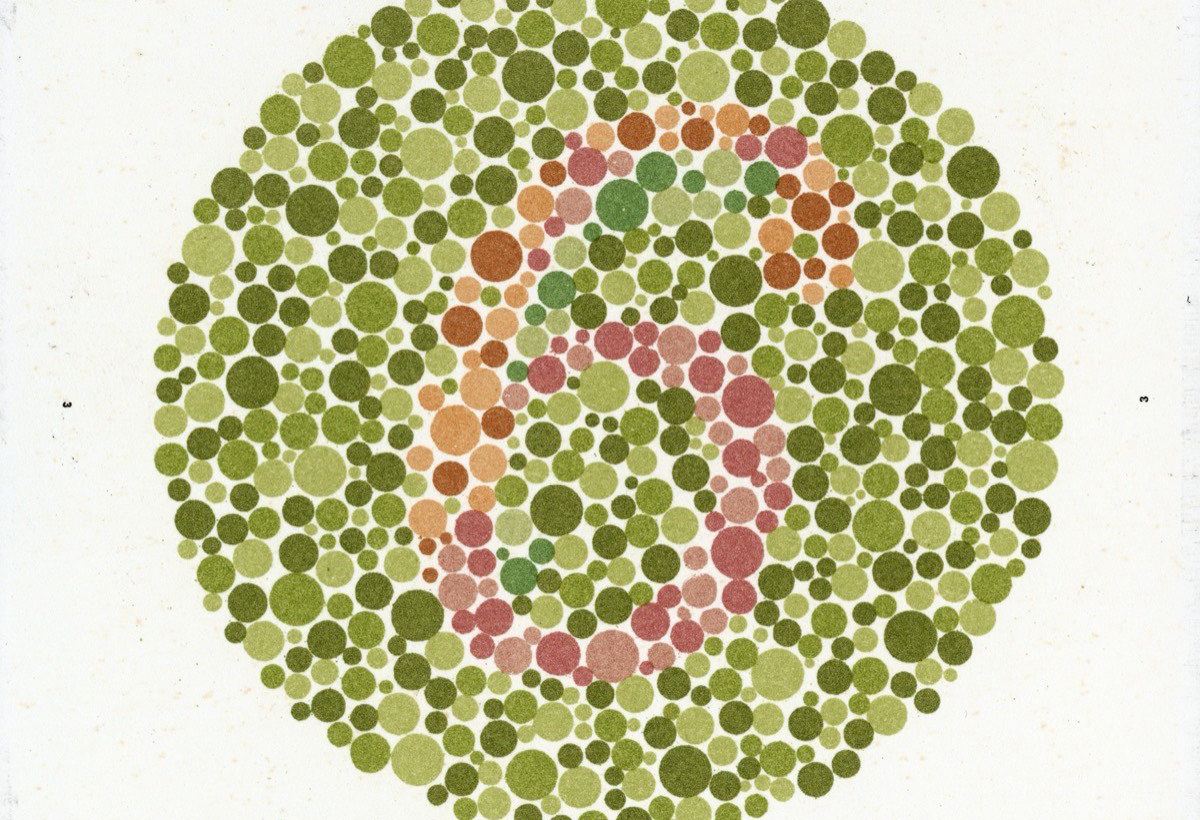
A colour vision plate. Wellcome Collection, CC BY 4.0. You just say which number you see.
4. Hearing. A quick check. For a car licence the rule is soft, and hearing aids are fine.
5. The machine. See the next section, this is the part people worry about.
6. Result. A few minutes later they tell you, and the report goes to the DGT.
The machine with two knobs
You sit in front of a screen. There are two winding tracks on it and a knob in each hand. Two dots move up the screen. You turn the knobs to keep each dot on its track.
That is it. It looks like an arcade game from 1985.
It measures coordination, not knowledge, so there is nothing to revise. Everyone is clumsy in the first ten seconds and the staff expect that. Being shaky does not fail you.
Some clinics add a second game. An object moves, disappears behind a shape, and you press a button when you think it comes out the other side.
Sleep well the night before. Skip the third coffee. That is the whole preparation.
The eyesight rule that catches people
For a car licence you need 0.5 vision with both eyes together. Glasses and lenses count, so wear them for the test.
If you only reach 0.5 with your glasses, you still pass. Your licence simply gets a note: you must wear them when you drive.
So take your glasses with you. People who leave them at home make the result worse than it has to be, for no reason.
Where to do it
Any DGT approved clinic. Pick your province on the official DGT list of centres and you get every centre near you.
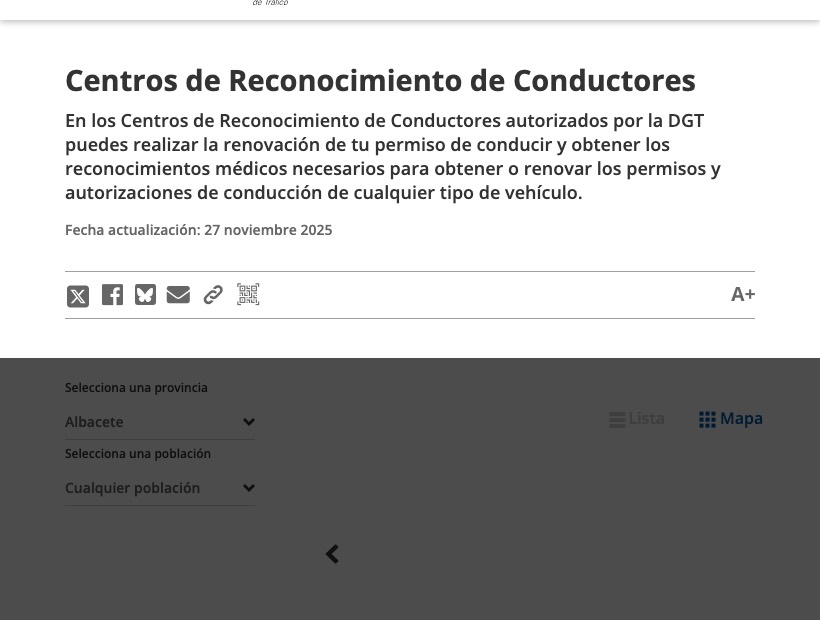
Screenshot: dgt.es. Choose your province, then your town.
What it costs
| What you pay for | Price |
|---|---|
| Clinic fee | 30 to 60 euros, usually around 40 |
| Renewing a licence | plus the DGT renewal fee, 24.58 EUR |
| First licence | clinic fee only |
Each clinic sets its own price, not the DGT. Prices change from city to city and even from street to street.
Ask what the price includes when you call. Clinics that handle a renewal from start to finish quote the fee and the tax together.
The three possible results
Apto. Fit to drive. Almost everyone gets this.
Apto con restricciones. Fit, with a condition attached. Usually glasses. Sometimes an automatic car only, no night driving, or a licence that expires sooner so they can check you again.
No apto. Not fit. This is rare, and it is almost never a surprise to the person it happens to. It comes from a serious untreated illness, not from being nervous.
Have a health condition? Bring your specialist's letter. Treated sleep apnoea, controlled epilepsy and diabetes usually end in a pass with a shorter licence, not a refusal.
The 90 day rule
Your report is good for 90 days.
Inside those 90 days you have to use it, either to apply for your exam or to finish your licence papers. Miss the window and you pay for the test again.
So get the order right. Do the medical check when you are ready to send everything off, not months before. If you are doing the paperwork yourself, book the theory test without a driving school as soon as you have the report.
Can you do it in English?
Often yes. Clinics in Barcelona, Madrid, Valencia and the coastal towns see foreign residents every day, and many will do the appointment in English. The forms are usually in Spanish.
Call and ask. The health questions are the one part where you both need to understand each other.
Questions people ask
How long does the psicotécnico take? About 30 minutes in total. The tests themselves take around 10 minutes. The rest is paperwork and waiting.
How much does the psicotécnico cost? Between 30 and 60 euros, depending on the clinic and the city. Around 40 euros is normal.
Can you fail the psicotécnico? It is possible, but rare. Being slow on the coordination machine does not fail you. A serious untreated illness can.
How long is the certificate valid? 90 days. Do the test when you are ready to use it.
Do I need to bring photos? No. The clinic takes your photo and sends it to the DGT with the report.
Do I need an appointment? Many clinics take walk-ins. Calling first still saves you a wasted trip, especially outside the big cities.